
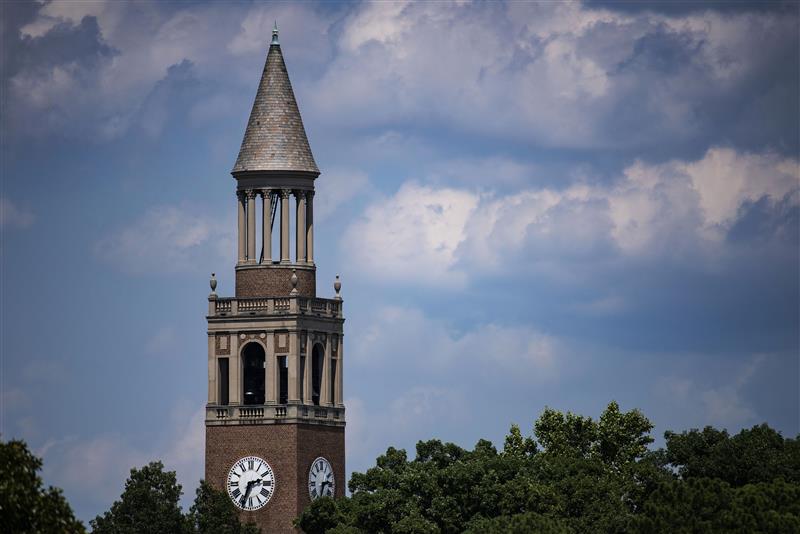
Join us as we celebrate the recipients of the 2026 Postdoctoral Awards for Research Excellence (PARE). This ceremony recognizes five outstanding UNC-Chapel Hill postdoctoral scholars whose exceptional achievements in research, leadership, mentoring, teaching, advocacy, and service have made a significant impact on the University and the broader research community. Winners to be announced soon.
This is an in-person event.
2026 PARE Winners:
Athena Stein, Department of Psychiatry, School of Medicine

“My research is redefining how brain stimulation is designed. Rather than imposing generic, synthetic waveforms conventionally used, I develop personalized neurostimulation interventions using an individual’s actual (endogenous) brain activity. I invented transcranial endogenous current stimulation and am currently testing its neurophysiological mechanisms and preliminary efficacy in a clinical trial in antenatal depression. At the same time, I am translating this framework into other brain stimulation modalities such as transcranial magnetic stimulation. My long-term goal is to understand the brain biomarkers underlying neurostimulation response in depression and other psychiatric disorders, and to establish endogenous neurostimulation as a new precision-treatment paradigm for these disorders.”
Evan Paules, Nutrition Research Institute

“I am focused on advancing precision nutrition. Diets and weight-loss drugs work well for some people and barely at all for others, and we cannot currently tell in advance who will not benefit from a given therapy. I study how the nutrients we eat, particularly choline, shape metabolic health, and I build metabolic profiles that identify whether a given treatment will work for someone. My goal is to turn nutrient status into a simple test that tells clinicians which treatment will help a patient, and to determine whether repleting certain nutrients can move people who do not benefit into the group that does.”
Grigory Terlov, Department of Statistics and Operations Research, College of Arts and Sciences

“My research lies in probability theory and its connections with other branches of mathematics and applied sciences. This work has two main threads: quantitative limit theorems, typically via Stein’s method, in random graph models and random optimization problems; and percolation on transitive graphs, especially in relation to measured group theory and measurable combinatorics. A common thread throughout my work is understanding how geometric and structural notions interact with randomness.”
Hyunji (Amy) Lee, Department of Computer Science, College of Arts and Sciences

“My research aims to build AI systems that can keep learning and adapting after they are deployed, rather than remaining fixed as the world, their users, and available information change. I study and develop how these systems can learn from real-world deployment by collecting and filtering experience into useful training and evaluation data, methods that help models recognize what they know and when to adapt, and systems that coordinate knowledge across models, memories, tools, and other agents. Ultimately, I want to create long-lived AI systems that remain useful, reliable, and coherent as they learn from ongoing interactions and changing environments.”
Kuan-Yi Lu, Department of Microbiology and Immunology, School of Medicine

“Why do antibiotics sometimes fail, even when drug concentrations far exceed the threshold normally required to clear an infection? My postdoctoral research at UNC-Chapel Hill has focused on solving the fundamental challenge of the systematic failure of antibiotics to eradicate infections within the body. Supported by a highly competitive NIH K99/R00 Pathway to Independence Award, my research integrates biology, chemical analysis, and animal modeling to identify why bacteria tolerate antibiotics during infections.”